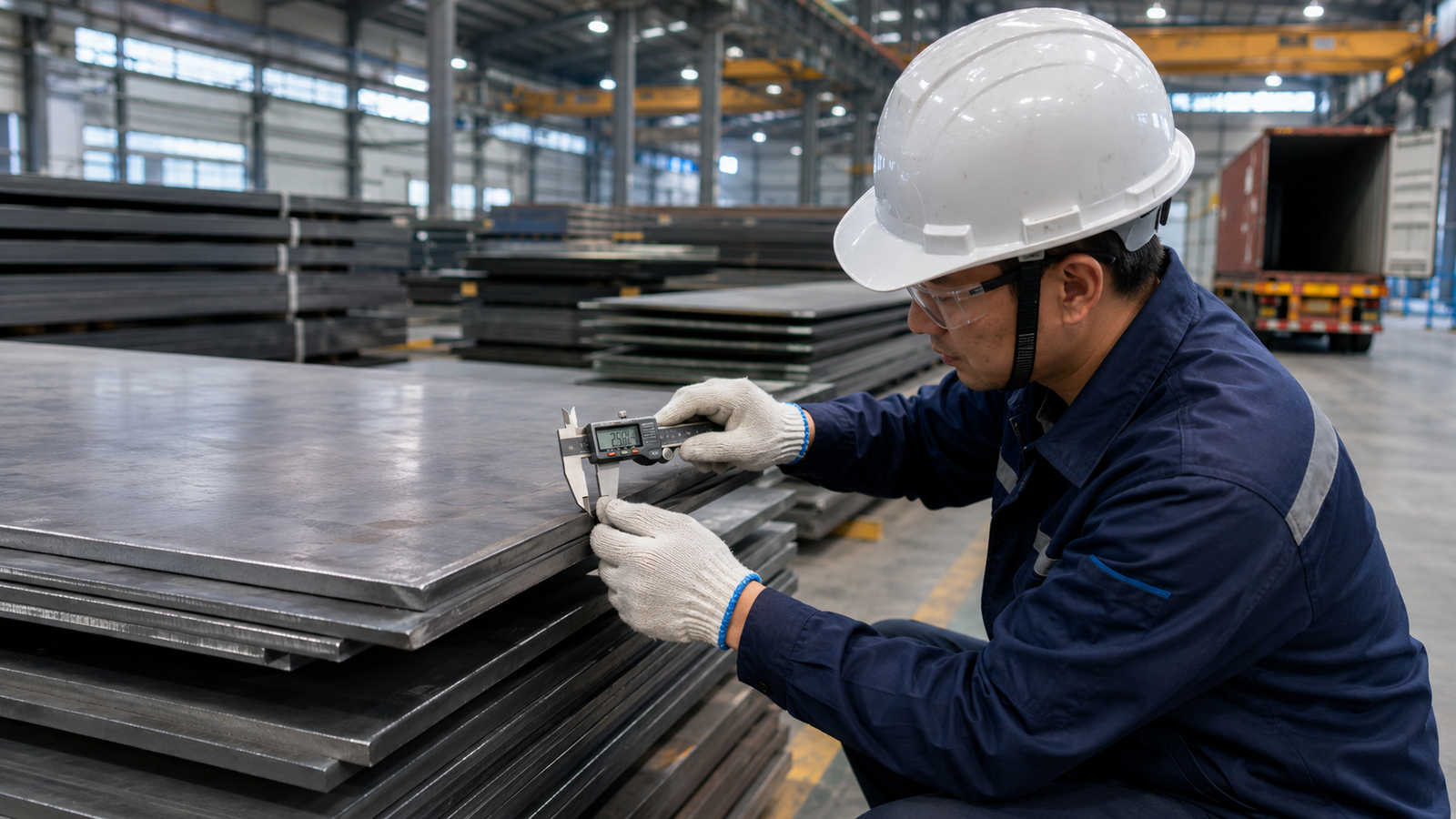
Why Is Thickness Tolerance One of the Most Overlooked Details in Steel Plate Purchasing?
“Why is the 6mm steel plate not exactly 6.00mm?”
This is one of the most common questions in carbon steel plate purchasing — especially for buyers who are importing steel for the first time.
In professional steel trading, this is related to thickness tolerance.
In simple words, nominal thickness and actual thickness are not always exactly the same. A steel plate marked as 6mm may have a small thickness variation due to rolling tolerance, production process, steel standard, and mill practice.
This does not automatically mean the plate is defective.
But it does mean buyers should understand the difference before placing an order.
For example, carbon steel plates are commonly supplied in sizes such as 1500mm × 6000mm, with thicknesses like 5mm, 6mm, 8mm, 10mm, 12mm or above.
For structural use, standards such as ASTM, EN, JIS, and GB may allow certain dimensional tolerances. ASTM A36 and Q235B are both widely used carbon structural steels, but buyers should still confirm chemical composition, mechanical properties, thickness tolerance, MTC, and project requirements before substitution.
Why does this detail matter?
1. Cost Control — actual thickness directly affects actual weight and total order value.
2. Project Accuracy — wrong thickness expectations may affect fabrication, welding, cutting, and assembly.
3. Container Loading — in many export cases, one 40HQ can usually load around 25–28 tons of steel products, depending on specification, packaging, and destination port rules.
4. Inspection Risk — third-party inspection may check thickness, size, surface, marking, packing, and MTC before shipment.
5. Application Safety — for structural projects, buyers should never rely only on price; standard and tolerance must match the end use.
A professional supplier will clearly discuss standard, tolerance, actual weight settlement, MTC, packing, and inspection before shipment.
A low-cost supplier may only say: “Same product, cheaper price.”
But in steel trade, “same thickness” on paper does not always mean the same product in real use.
Of course, steel plate quality is also affected by raw material, rolling process, flatness, surface quality, cutting accuracy, storage, and handling.
So before comparing prices, buyers should confirm:
1. Specification
2. Quantity
3. Destination port
4. Application
5. Required standard
6. Purchase schedule
Because in carbon steel purchasing, the cheapest offer is not always the lowest-risk choice.
#CarbonSteel #SteelPlate #SteelExport #SteelTrading #ASTMA36 #Q235B #SteelManufacturing #SteelProcurement #ConstructionMaterials #MetalFabrication #InternationalTrade #SteelSupplier